Strategic Framework: The Five-Pillar Architecture for Modern E-Learning
1. Executive Context: The Great Education Reallocation
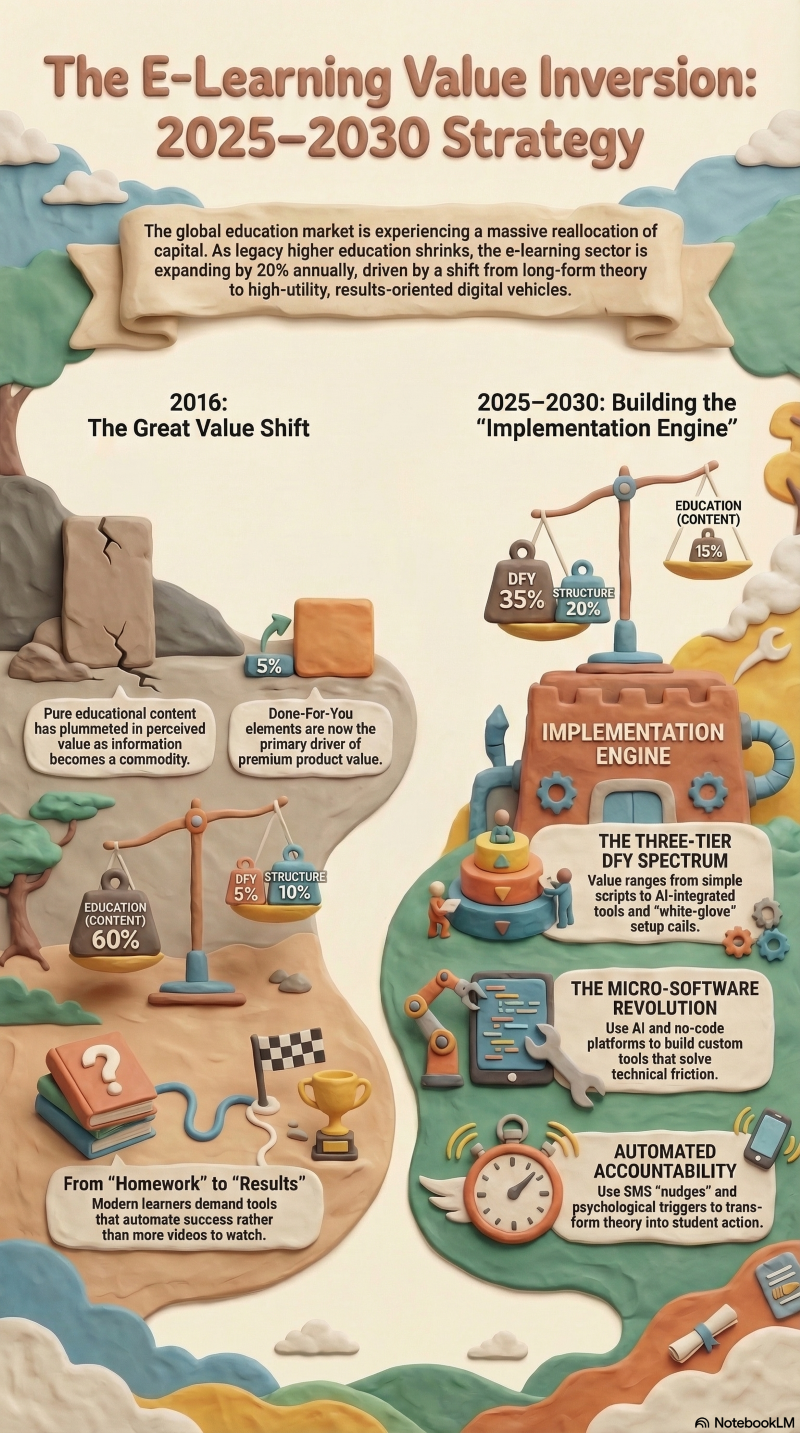
The global education landscape is currently defined by a massive reallocation of both capital and trust. We are witnessing a systemic “displacement of trust” from legacy institutions toward agile, digital-first innovators. While the total global education market represents a $10 trillion pie, the internal distribution is shifting violently. Formal higher education is currently shrinking at a rate of 3% annually, while the e-learning sector—valued at $350 billion in 2025—is expanding by 20% per year.
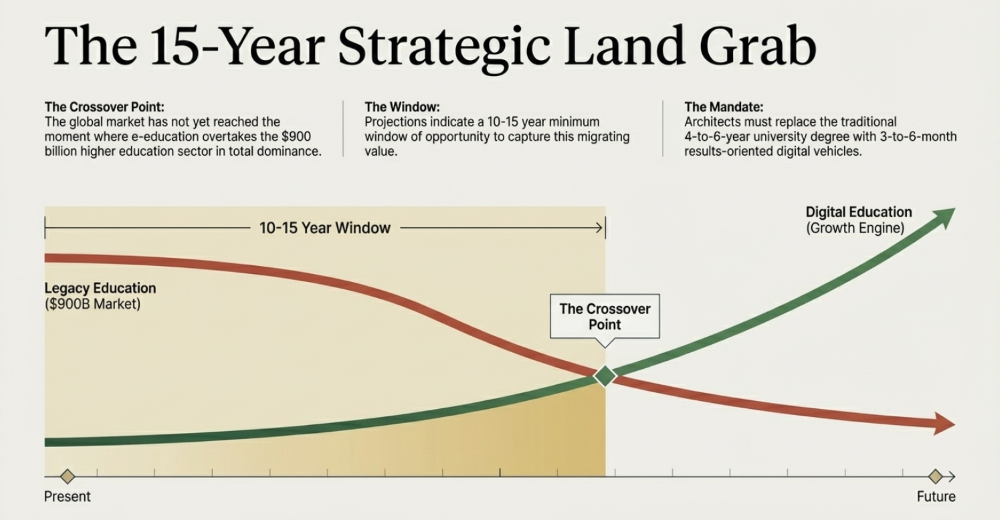
The following data illustrates the current landscape and the strategic “land grab” window:
| Market Segment | Current Market Size (2025) | Annual Growth Rate (CAGR) | Strategic Outlook |
| Global Education (Total) | $10 Trillion | Variable | Massive Capital Shift |
| Higher Education | $900 Billion | -3% (Shrinking) | Institutional Obsolescence |
| E-Learning / Digital Ed | $350 Billion | +20% (Growing) | Primary Growth Engine |
Crucially, we have not yet reached the “Crossover Point”—the moment digital e-education overtakes the $900 billion higher education market in total dominance. Projections indicate a 10-15 year minimum window of opportunity for innovators to capture this migrating value. The next decade represents a critical phase for architects to replace the traditional 4-to-6-year degree with 3-to-6-month results-oriented digital vehicles. However, to survive this transition, the product itself must move beyond “information delivery” and toward high-utility implementation.
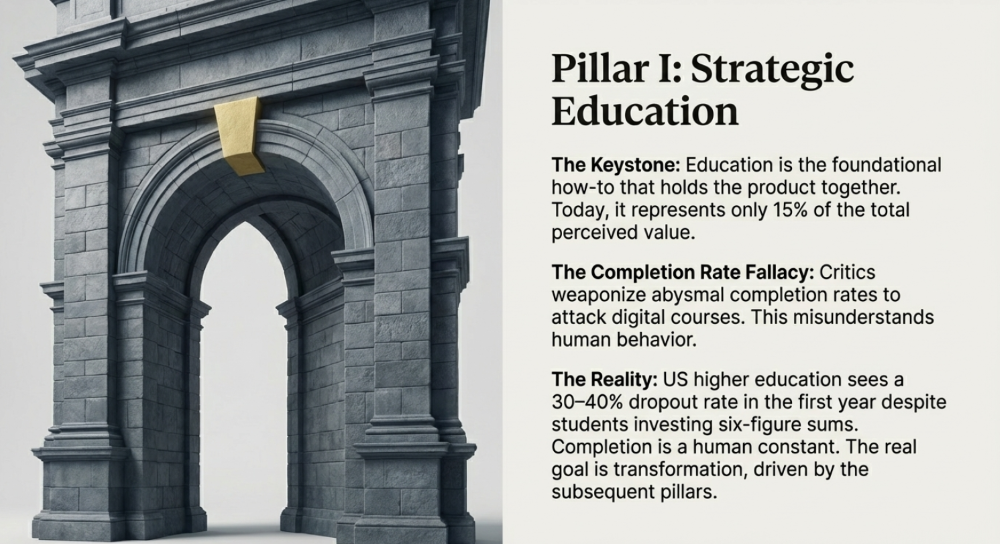
2. The Keystone: Pillar I – Strategic Education
In the architecture of a premium offer, Education is the keystone. It is the foundational “how-to” that holds the product together, yet it has become a “Commodity Trap” for those who rely on it too heavily. Many creators fall into the trap of equating value with video duration, believing that 15 hours of recorded footage constitutes a product. In 2025, recording videos is merely a baseline requirement, not a competitive advantage.
Value Arbitrage and the 15% Reality
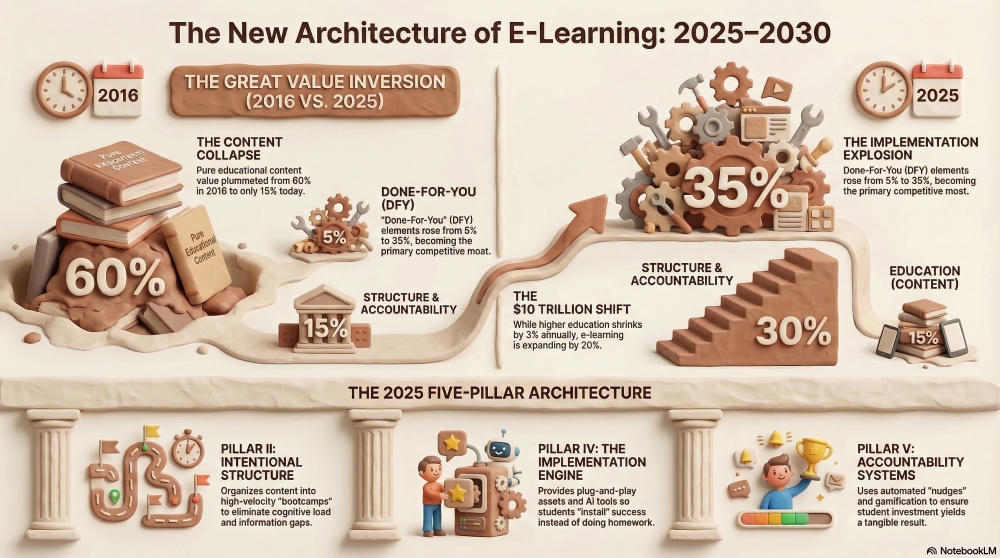
The market has performed a radical revaluation of pure information. In 2016, the educational content itself represented roughly 60% of the offer’s perceived value. By 2025, that value has plummeted to 15%. You are no longer selling information; you are performing “Value Arbitrage”—converting raw information into a specific, usable result.
The Completion Rate Fallacy
Critics often weaponize “abysmal completion rates” to suggest that digital courses are failing. This is a misunderstanding of human behavior. Completion is a “human constant,” not a format-specific failure. US higher education sees a 30–40% dropout rate in the first year alone, despite students investing six-figure sums. To an architect, completion rates are a minor variable; the real goal is student transformation, which is driven by the pillars that follow.
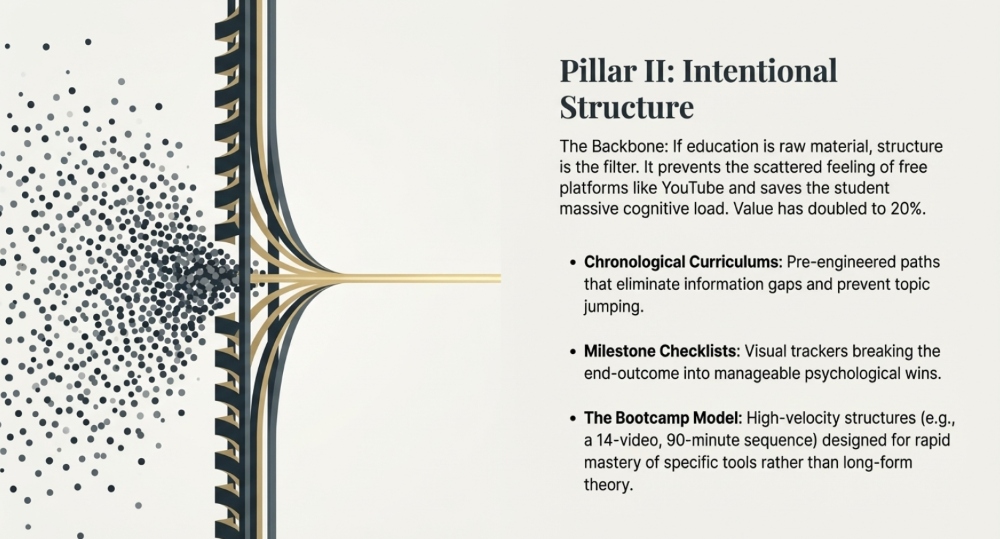
3. The Backbone: Pillar II – Intentional Structure
If education is raw material, Structure is the filter. It is the backbone that organizes content to facilitate student effort, preventing the “scattered” feeling typical of free platforms like YouTube. Professional products command a premium because they save the student the cognitive load of curriculum curation.
Components of Strategic Curation
- Chronological Curriculums: A pre-engineered path that eliminates information gaps and prevents “topic jumping.”
- Milestone-based Checklists: Visual trackers that break the end-outcome into manageable psychological wins.
- The Bootcamp Model: High-velocity structures, such as a 14-video, 90-minute bootcamp, designed for rapid mastery of specific tools (e.g., software onboarding) rather than long-form theory.
In the 2025 Information Age, structure has doubled in value from 10% to 20%. When information is infinite, the guide who provides the most efficient “short-cut” through the noise wins the market.
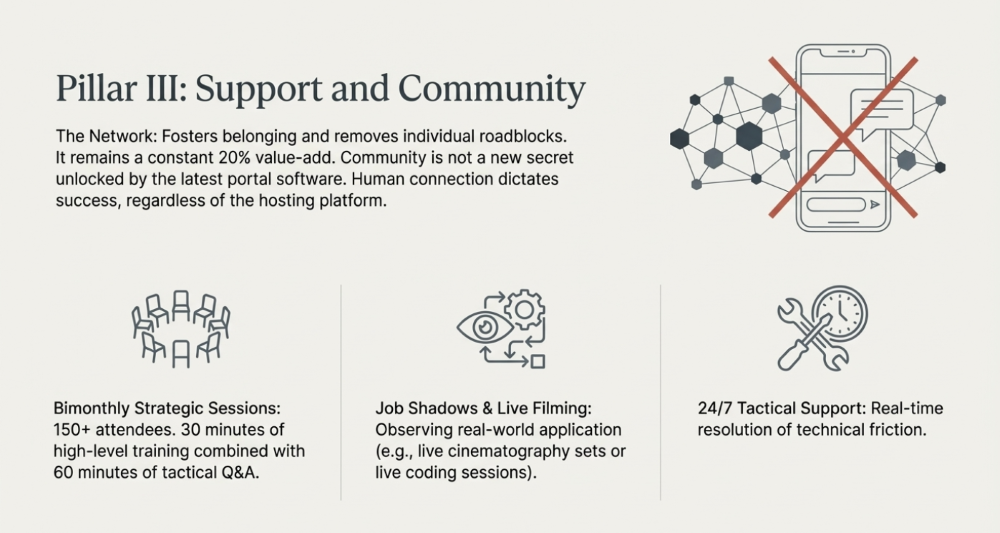
4. The Network: Pillar III – Support and Community
The third pillar provides the network required to foster a “sense of belonging” and overcome individual roadblocks. However, a modern architect must look past the “Software Illusion.” Current marketing for platforms like Skool.com suggests that community is a “new” secret. In reality, human connection has been a constant 20% value-add since 2016, regardless of whether it is hosted on Slack, Discord, or a dedicated portal.
High-Impact Delivery Methods
- Bimonthly Strategic Sessions: Live coaching calls (e.g., 150+ attendees) combining 30 minutes of high-level training with 60 minutes of tactical Q&A.
- Job Shadows & Live Filming: Moving beyond chat apps to allow students to observe real-world application (e.g., watching a professional cinematography set or a live coding session).
- 24/7 Tactical Support: Direct access to a team to resolve technical friction in real-time.
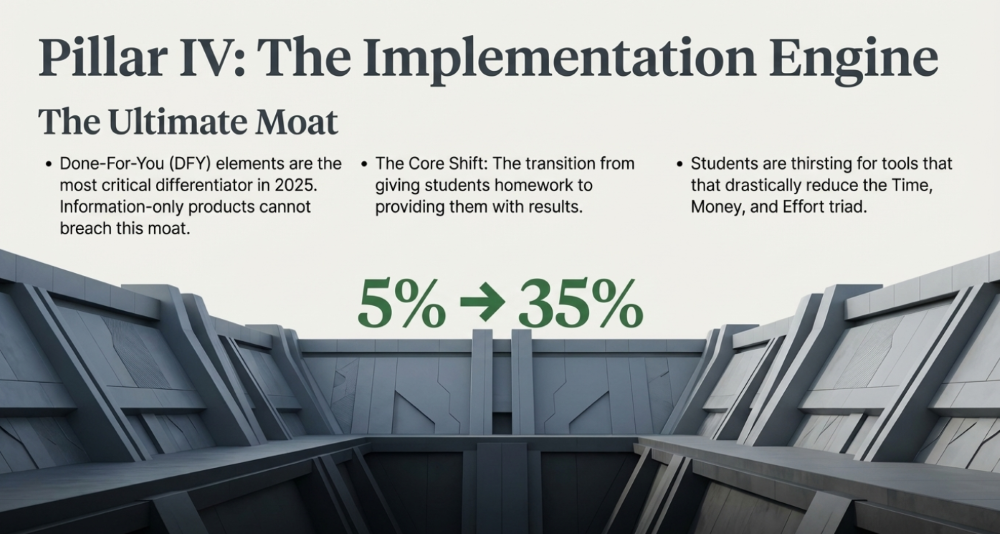
5. The Implementation Engine: Pillar IV – Done-For-You (DFY) Elements
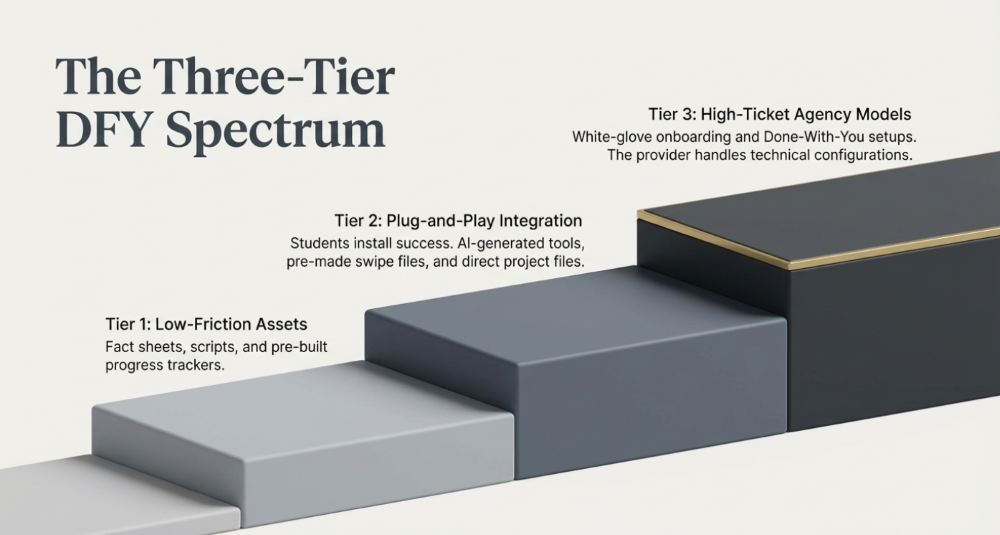
Pillar IV is the most critical differentiator in 2025. This is the “Implementation Engine”—the shift from giving students “homework” to providing them with “results.” This pillar creates a competitive “Moat” that information-only products cannot breach.
The Three-Tier DFY Spectrum
- Tier 1: Low-Friction Assets: Fact sheets, scripts, and progress trackers.
- Tier 2: Plug-and-Play Integration: AI-generated tools, pre-made swipe files, and Premiere Pro project files. These allow students to “install” success.
- Tier 3: High-Ticket Agency Models: “White-glove” onboarding and “Done-With-You” setup calls where the provider controls the student’s screen to handle technical configurations (DNS settings, funnel builds, etc.).
Universal Application: The Japanese Language Example
DFY elements are not limited to business niches. Consider a Japanese language program:
- AI Pitch-Accent Coach: A tool that analyzes a student’s speech in real-time, providing a waveform pitch graph to correct pronunciation instantly—saving weeks of manual feedback.
- Grammar/Vocabulary Checker: A custom GPT that flags awkward phrasing and suggests natural alternatives for spoken Japanese.
- Auto-Conjugation Guide: A software tool that instantly generates all verb forms (past, present, negative) with example sentences upon input.
The value of DFY has exploded from 5% (2016) to 35% (2025). Students are “thirsting” for tools that reduce the “Time, Money, and Effort” triad.
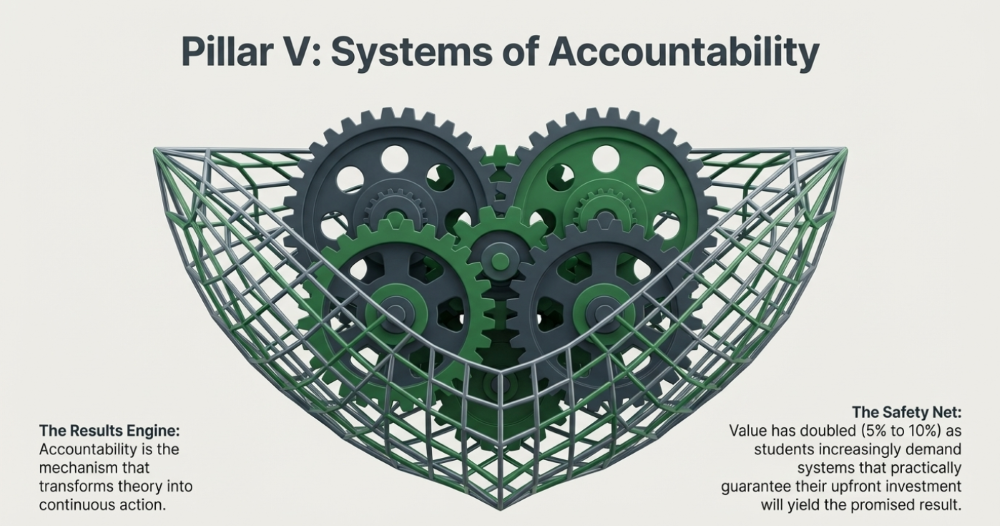
6. The Results Engine: Pillar V – Systems of Accountability
Accountability is the mechanism that transforms theory into action. It has doubled in value (5% to 10%) as students increasingly seek “safety nets” to ensure their investment yields a result.
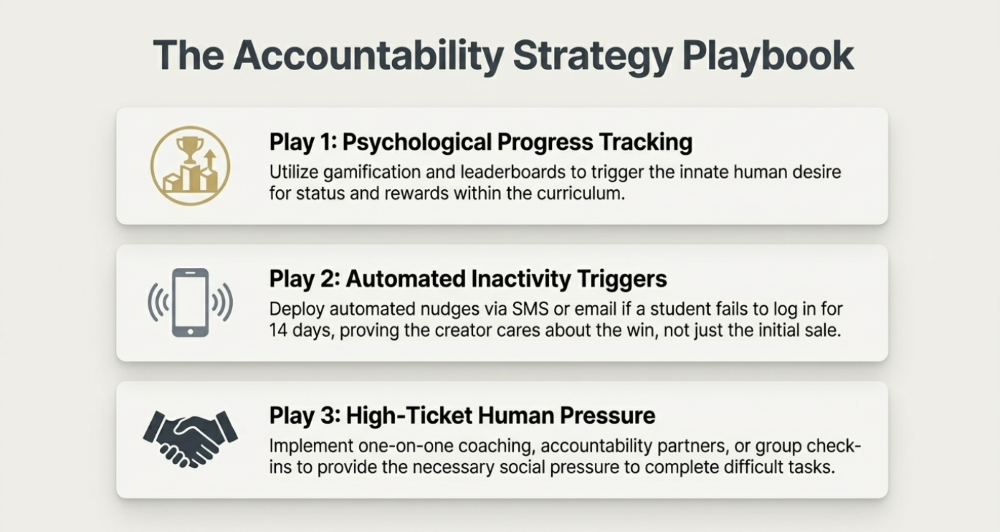
The Accountability Strategy Playbook
- Play 1: Psychological Progress Tracking: Utilizing gamification and leaderboards to trigger the human desire for status and rewards within the curriculum.
- Play 2: Automated Inactivity Triggers: Deploying automated “Nudges” via SMS or email if a student has not logged in for 14 days. This shows the creator cares about the win, not just the sale.
- Play 3: High-Ticket Human Pressure: Implementing one-on-one coaching, accountability partners, or group check-ins to provide the necessary social pressure to complete difficult tasks.
7. Strategic Synthesis: The 2016 vs. 2025 Evolution
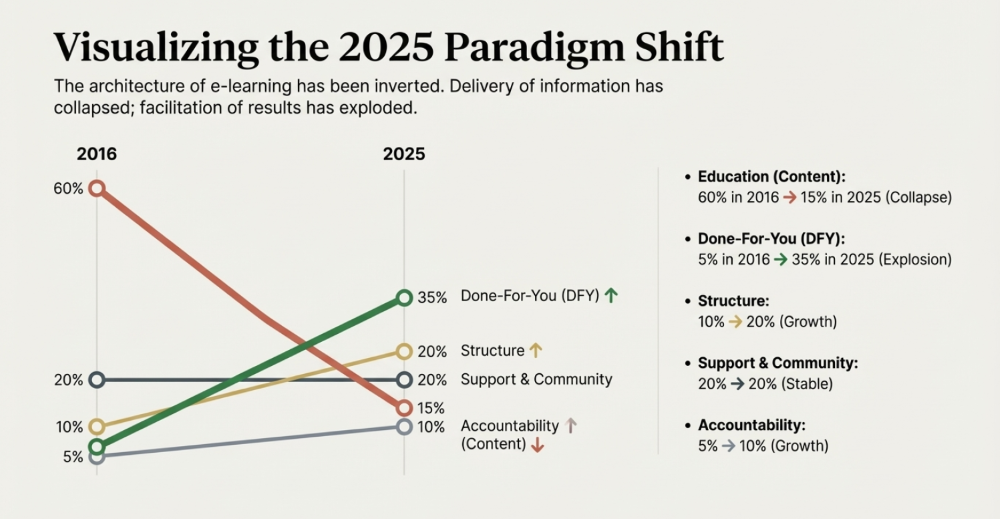
The architecture of e-learning has been completely inverted. The focus has shifted from the delivery of information to the facilitation of results.
Value Distribution Shift Table
| Pillar | 2016 Value Weight | 2025 Value Weight | Trend |
| I. Education (Content) | 60% | 15% | Collapse |
| II. Structure | 10% | 20% | Growth |
| III. Support & Community | 20% | 20% | Stable |
| IV. Done-For-You (DFY) | 5% | 35% | Explosion |
| V. Accountability | 5% | 10% | Growth |
Final Directive: The Micro-Software Revolution
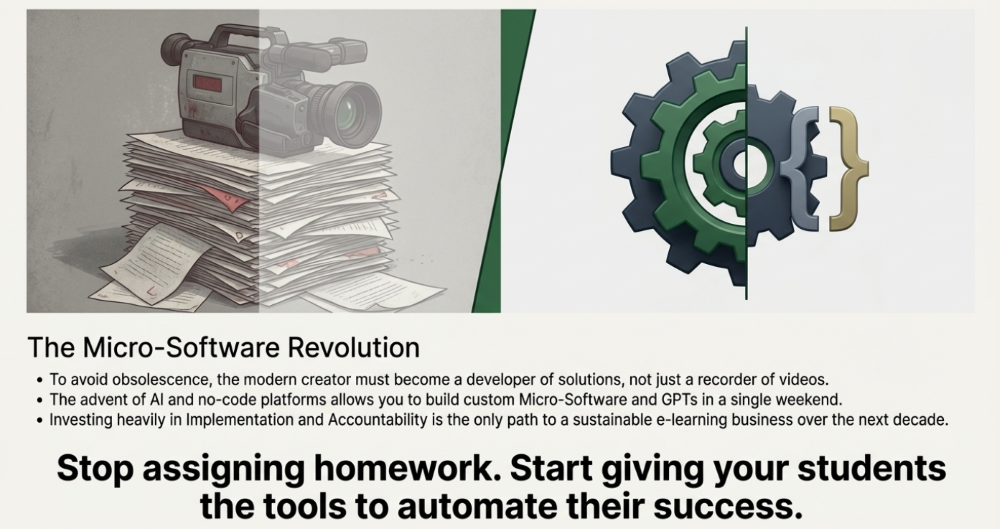
To avoid obsolescence, the modern creator must become a developer of solutions, not just a recorder of videos. The advent of AI and no-code platforms allows you to build “Micro-Software” and custom GPTs in a single weekend—tasks that previously required six figures and years of development.
Investing in Pillar IV (DFY) and Pillar V (Accountability) is the only way to build a sustainable business in the next decade. Stop giving your students more homework; start giving them the tools to automate their success.